Categories
Uncategorized

A Cattle Call for Unity

My fifth birthday was less than two weeks before the attacks of September 11, 2001. All I can remember from that day and the days following was sitting on our living room coffee table in my baseball uniform, holding my bat and mitt, while my dad sat nearby and had a staring contest with Fox News. I also remember talking with my parents, and they explained how the day unfolded. Originally everyone thought it was a small plane and a pilot had made an error. Then the second plane hit. We now knew it wasn’t an error… or small plane.

As a 5-year-old, it seemed significant, but also you just assume stuff like 9/11 happens regularly. In church, you learn about sin and the battle of good versus evil. As a young boy, you play “army man” in the backyard and something about war and fighting is just fascinating. This seems like something that just happens when you live in a fallen world. What I didn’t learn about until years later was the America of September 12, 2001.

People reference the day after 9/11 every time we face massive division. Even though it happened in New York, people older than me talk about the patriotism and unity in their community, no matter where they lived in the country. Police, firefighters, and first responders nationwide share how people would honk and wave and thank them, even if they had no ties to New York or Ground Zero. I was too young to realize how a 9/12 America felt, but everyone I ask speaks of it fondly, usually concluding with a “it’s sad it takes something like a 9/11 for us to come together” or “if only we could have a 9/12 country without going thru another 9/11.”
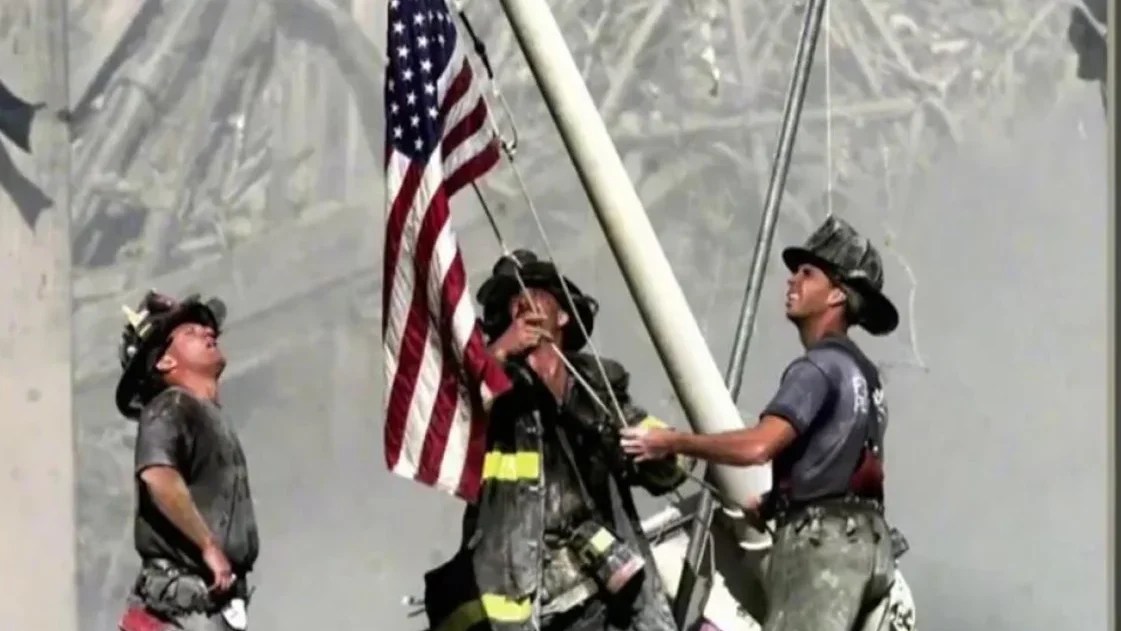
A couple times a year, I will go on YouTube and watch a handful of sports videos that I know will bring me chills or tears. There’s the Mike Piazza home run at the first baseball game in New York after 9/11. People have said how that score wasn’t for the Mets, or even New York, but for the nation. I personally love the one of Sammy Sosa at Wrigley Field for the first Cubs home game after 9/11. Before the game, the Dominican athlete greeted fans by running around the outfield holding a small American flag. That was only overshadowed by his home run that game, where he brings the little flag back out as he rounds first, and jogs the bases with Old Glory in his right hand like a toddler running around with a sparkler.

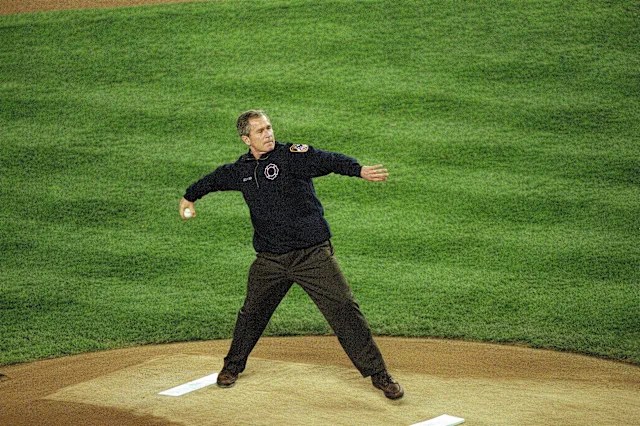
At game 3 of the World Series in October 2001, the Yankees hosted the Arizona Diamondbacks in New York. The first pitch, which usually happens well before most of the crowd arrives, is seen by the sold-out stadium and felt by the nation. Newly-elected-president George W. Bush comes out of the dugout in an FDNY pullover (which not just showed support for the first responders, but also concealed a bulletproof vest). He waves to the crowd, throws a strike, waves again, then is escorted off the mound by “USA” chants.

A little more than a decade later, Boston experienced its own evil when runners and spectators at the Boston Marathon were killed by bombs hidden near the finish line. The hockey game scheduled for the same day was postponed, but two days after the terrorist attack that killed three and injured nearly 300 more, the Boston Bruins hit the ice with singer Rene Rancourt. They had hoped to take minds off of the bombings for even just a few hours. Rancourt sang the national anthem at Bruins games for 42 years, and at one point said the game two days after the bombing was the only anthem he didn’t sing. Even though he walked out on the rug in his tuxedo, the crowd at Boston’s TD Garden took over and sang. The city needed that one.
My elementary school years were 9/11 and the war in Iraq. Middle school was the financial crisis and my introduction to politics with the Obama-McCain election. High school was the Benghazi attacks, Boston Marathon bombing, genesis of Black Lives Matter, and the takeover of social media platforms from widely-used smartphones.

In college, it was Ferguson, same-sex marriage legalized nationwide, Trump shaking up the 2016 election and the institutions, #MeToo, and the push for sharing preferred pronouns (I still remember the first time the pronoun thing came up on syllabus day in 2018… myself plus 35 others including the professor didn’t know what was being asked, so it was explained to us by two young ladies sporting haircuts that you would have if you played the pronoun game in its early stages).

Then two years later, the COVID-19 coronavirus variant shut down the world, George Floyd resurrected the BLM that hadn’t really shown up since Ferguson, the 2020 election was decided via snail mail, and by January 6, 2021, and the subsequent inauguration of Biden behind a fortified Capitol, the nation of 9/12 I had heard so much about seemed like an urban legend.

I hope we return to it. I long for the country that waved American flags at ballgames and chanted “USA” even if it was towards a president they didn’t like. Now a president gets shot in the ear and a not-small number of people complain the shooter missed the head.

I could talk extensively about unity or lack thereof (and hope to in future posts/podcasts), but as of late September 2025, I am not sure how attainable it is outside of Christianity. And even then, it’s still really hard at times.

There’s a story of American evangelist Billy Graham at a meeting in Germany with post-WWII chancellor Konrad Adenauer. Graham is asked by Adenauer, a Catholic, if Graham truly believes in the resurrection of Jesus Christ. Graham answers something close to, “Of course! If there is no resurrection, then I have no gospel left to preach.” Adenauer replies, “Mr. Graham, apart from the gospel of Jesus Christ, I know of no other hope for mankind.”

As Christians, we are united by the same goal, serve the same God, submit to the same law, and receive the same identity in Christ. There is true unity amongst diversity in this. As Americans, we can’t agree on goals, we serve different gods, have complete different views of the Constitution, and are constantly being divided by earthly identities. You can’t just legislate your way out of this. There is no solution for unifying apart from Christ.

On September 12, 2001, our country looked completely different than it looks today. Demographically, economically, religiously, politically, socially, even physically. By almost every metric, we are worse off and it is showing. If you are a Christian residing in the United States, please join me in praying and working to redirect our nation back towards Christ; then towards each other. There is no legitimate hope outside of the finished work of Christ. There is no lasting help outside of the Church.

In a country where we, believers included, have split teams into who is vaxxed and who isn’t, who is white and who isn’t, and who gets talking points from MSNBC and who uses Newsmax (spoiler alert; media conglomerates are all owned by the same few companies), unity will not be easy or even natural at times. However, it is vital.

We can bicker about differences like school choice or infant baptism later on. Right now, all believers and patriots have to come together while “the fields are ripe and ready for harvest.” Catholics who preach Christ crucified in Latin Mass, and evangelicals whose pastor wears jeans to church, unite! “I like Trump’s policies, but not his rhetoric,” and “I love Trump because he says what we’re all thinking,” unite! Those who don’t follow politics and those who watch the news like a hawk, unite!

We have souls to save, and a nation to rescue.

Categories
Uncategorized

USA: Not perfect, but mine

It was a few months shy of my 22nd birthday the very first time I ever left the United States. The God-given lifelong interest in different cultures, accompanied by a pull to do ministry, led to a month in Rwanda for mission work that summer. When I shared with people where our team was going, and how it was my first trip abroad, there was typically a response about how I would be in for a “major culture shock” or something about not drinking the water. Well, there actually was a slight culture shock, but it was in the opposite direction.

I suddenly realized what made America so unique.

As the trip came to an end, my two-decade-backed sense of American patriotism only grew. In fact, the overwhelming sense of pride I took in my home was only relieved by running to the store when I returned to Nashville so I could buy an American flag sticker for my car.

Since that trip, I have been awarded opportunities to visit several other nations on missions. Each trip produces a blend of looking at other cultures wondering why we don’t incorporate some of their customs here, and a stronger appreciation for all of the things we “got right” in the U.S. that other places didn’t.

Just two years after that initial trip, the world shut down over a virus and international travel was halted. Local governments around the nation followed the guidance of a select few in Washington and lockdowns became commonplace. People were told to “do their part, stay apart” and limit any travel outside of your home. We as humans are not designed to be isolated, but the side effects of isolation weren’t truly felt until after those first few months.

Some states pushed for masks and remote work, while others acted like there was no pandemic at all… good way to drive a wedge. Some people thought the Trump administration wasn’t doing enough to take the virus seriously, which costed lives, while others thought Trump’s team was flirting with tyrannical overreach by the 15-day-curve-flattening tactic. The wedge was deepened. We were in a whole new way of life, forming our opinions on what was really happening, and cementing those opinions with tailored social media feeds.

Then, it happened. Two-ish months in. The American people, divided and stir-crazy, were hit with bodycam footage of a man dying while in custody of Minneapolis police officers. Not only did the backlash prompt debates around cause of death and proper policing, but these debates quickly morphed into differing stances towards the United States of America as a whole.

And that is where my reverse culture shock kicked back in.

While some Americans wanted to burn down the institutions– some quite literally did– and start over, I began to study our history and recall some of the lessons that were only learned while overseas. Five years have passed since the 2020 summer, and although that madness has ceased, the gratitude for my country has not.

We have no control over where we are born. We have no say in who our parents are, what time in history we live, and the ethnicity we display. Only the sovereign Lord of the universe determines those things.

God in His sovereignty placed me in the United States of America in 1996; raised by a devout Christian set of parents. I had zero say.

However, the older I have gotten, and the more I have studied scripture, the tug to steward and serve my country has strengthened. Not because it is perfect, but because it is mine!

I often think of a quote from the English author and apologist G.K. Chesterton. “Men did not love Rome because she was great. She was great because they had loved her.” If God has naturalized me as an American, why would I not try to love my nation? Do I not want to make the U.S. as great as it can be? If I were born in Estonia, or Cambodia, or Botswana, would I not want to help make them the greatest versions of themselves? How easy it would be to tear down something because it isn’t perfect. How rewarding it would be to help improve.

Even now, as people in America criticize America, foreigners aren’t deterred. We still have a great founding, and other nations know it. The same way fish don’t know they’re in water, complaining Americans are surrounded by prosperity– making it possible to gripe about the present and criticize the past.

Yet, people line up to come here. I attend naturalization ceremonies once a month for work, and sitting in these courtrooms are people of all ages from dozens of countries, some crying, some smiling, most waving American flags, all leaving their original homes to construct new lives here.

I am not arguing that Americans don’t appreciate our country, and you can only appreciate America if you are born elsewhere. But what I have seen on my mission trips, and what most of the world experiences firsthand, is that most places don’t offer what we offer. If you get hurt, you can go to a hospital without insurance and still receive care. We have water (even with its nonsense chemicals added) that is safe to drink almost everywhere you go. We have public schools, so affluent people in other nations don’t have to sponsor you from afar to receive an education. Even with corruption and government incompetence, we are still extremely blessed.

We just celebrated our 250th Independence Day yesterday. It is a sacred day as an American. In fact, while drafting the Declaration of Independence, John Adams mentioned how our birthday should be “commemorated as the Day of Deliverance by solemn acts of devotion to God Almighty.”

But this time next year will mark 250 years as a nation. Most empires fall around the quarter-millennium mark. Surely not America, because we are different… right? Can we avoid demise? Or at least prolong it?

I don’t know. But I do know this.

The Bible talks extensively about the role of nations. God’s hand has established their borders, determined their power, and directs the hearts of kings as if they were rivers. We have a constitution recognizing that all humans, no matter their origin or status, have value solely because they were created by this God.

And not only do regular, ordinary citizens have worth, but those in power should remember this inalienable worth, and avoid doing evil or treating citizens merely as pawns and subjects.

The Framers and founding fathers were cognizant of the human condition. Pushing for small government, Thomas Jefferson, who wasn’t even a Christian, believed if humans are incapable of self-governance, how could individuals ever govern the masses? We may have lost this along the way, which is proven by a bloated federal system, but most countries never had this sentiment to begin with. There are countries with more people, more natural resources, or more unifying homogeneity that can’t seem to grasp what dead men penned long ago in an “outdated” document.

Are we perfect? No shot. Are we what we once were? No, whether that’s for better or for worse. But we are still America. And our governing literature boasts the longest reign of any country’s constitution active today. And that same constitution was inspired by the very active and living Word of God. It is thru both documents, the Holy Bible and the U.S. Constitution, that we are the powerful and desirable nation that we are today.

We are a nation. We are not an idea. We were forged by rebels, built by settlers, protected by warriors, and now inhabited by nearly 350 million people from all different corners of the globe. And those of us today have it much easier than our founders ever did. It is time to build.

It’s easy to criticize and complain. At times, it’s even fun. It’s easy to point at things from 150, 250, or even 400 years ago to avoid any accountability or maintain complacency. It’s harder to take an honest look at the U.S. today and decide to step up, contribute, and help steer the ship in the right direction.

The United States of America is unique. But honestly, so is every country. God gives countries distinct cultures and identities so that He may be glorified and people will seek Him. It doesn’t mean they’re equal or similar, but countries as a concept are unique.

America truly is unique. And it is different than anywhere else. I wholeheartedly believe this. I can’t get over the fact we have sporting events grossing tens of millions of dollars, and before the game we do flyovers consisting of more aircraft than many countries’ air fleets. For fun. We just do that because we can. It’s awesome. I hope we keep doing it.

As C.S. Lewis once said regarding patriotism, “The last thing we want is to make everywhere else just like our home. It would not be home unless it were different.”

I love you, America. Thank you for a wild 250 July Fourths. If God wills it, here’s to many more.

Categories
Uncategorized

CATTLE CALL PODCAST

CCPf2

What began as interviews with different types of people answering same types of questions, has shifted into christian, conservative topics around politics, health, and whatever is current!